
Export Logistics from Panama for Premium Tropical Programs
Key factors for cold chain execution, transit planning, and reliable tropical export programs from Panama.
Export Logistics from Panama for Premium Tropical Programs
Exporting tropical fruits from Panama isn't simply packing and shipping. It's a chain of critical decisions where every hour counts. If logistics fail, the product loses quality — and with it, your commercial margin.
In this article, I'll explain the key factors for executing tropical exports from Panama: from harvest to destination port.
Why logistics differ for fresh products
Unlike dry goods or manufacturing, fresh tropical products have:
- Limited shelf life: An MD-2 pineapple has 21-28 days post-harvest under optimal conditions
- Temperature sensitivity: Variations of 2-3°C can accelerate ripening or cause cold damage
- Phytosanitary requirements: Each market has specific regulations that block non-compliant shipments
- Seasonality: Harvest windows are fixed — you can't simply "produce more"
This means logistics execution is non-negotiable. It either works, or you lose the shipment.
Panama's port infrastructure
Panama has a unique geographic advantage: access to two oceans. For tropical exports, this translates to options:
Port of Balboa (Pacific)
- Ideal for US west coast destinations, Asia
- Frequent connections to Los Angeles, Long Beach
- Less congestion than Colón
Port of Colón (Atlantic)
- Direct connections to Europe and US east coast
- Higher traffic volume
- Most active transshipment hub in the region
PSA Panama Port
- Modern operations with specialized equipment
- Good capacity for refrigerated containers
- Efficient inspection processes
Real transit times
The times shipping lines quote are "port to port." But for real planning, you need to consider the full chain:
| Destination | Maritime transit | Total chain (harvest to delivery) |
|---|---|---|
| Miami, FL | 3-4 days | 7-10 days |
| Los Angeles, CA | 8-10 days | 14-18 days |
| Rotterdam, NL | 12-15 days | 18-24 days |
| Toronto, CA | 5-7 days | 12-16 days |
| London, UK | 14-16 days | 20-26 days |
Important: These times assume everything flows smoothly. Always add a 2-3 day buffer for contingencies.
Cold chain: the critical factor
In tropical products, cold chain isn't optional. A 30-minute temperature break can compromise the entire container.
Optimal temperatures by product
| Product | Temperature | Humidity | Shelf life (days) |
|---|---|---|---|
| MD-2 Pineapple | 7-8°C | 85-90% | 21-28 |
| Dragon Fruit | 7-10°C | 85-90% | 14-28 |
| Papaya | 7-10°C | 85-90% | 14-21 |
| Green Coffee | 18-22°C | 60-65% | 180+ |
Critical break points
-
At farm: Immediate pre-cooling post-harvest (first 4 hours are critical)
-
Transport to packhouse: Refrigerated trucks or during cool hours
-
At packhouse: Cold room before consolidation
-
Loading to container: Power connection during loading, never leave disconnected
-
At port: Monitor connected container in yard
-
In transit: Genset running, remote monitoring if possible
-
At destination: Immediate inspection, don't leave in yard without power
Required documentation
Each market has specific requirements, but base documentation includes:
Export documents
- Phytosanitary certificate (MIDA in Panama)
- Certificate of origin
- Commercial invoice
- Packing list
- Bill of Lading (B/L)
For specific markets
United States:
- Prior Notice (FDA) — 15 days before arrival
- Facility registration (if applicable)
- FSMA compliance
European Union:
- Sanitary certificate
- TRACES NT (electronic pre-notification)
- Declaration of conformity
Canada:
- Importer license
- CFIA pre-notification
Commercial terms
Lane economics depend on product, volume, shipping frequency, season, and the agreed incoterm — so we don't work from a published rate sheet. Each program is quoted to its specification, against your lanes, delivery schedule, and required certifications.
If you're building a program around Panama MD-2 pineapple or another premium tropical, contact us and we'll return commercial terms structured to your volume and destination.
Maritime vs. air: when to use each
Maritime (refrigerated container)
Use when:
- Volume justifies container cost
- Product can withstand 10+ days of transit
- Margin can absorb logistics cost
- You have a 3-4 week planning window
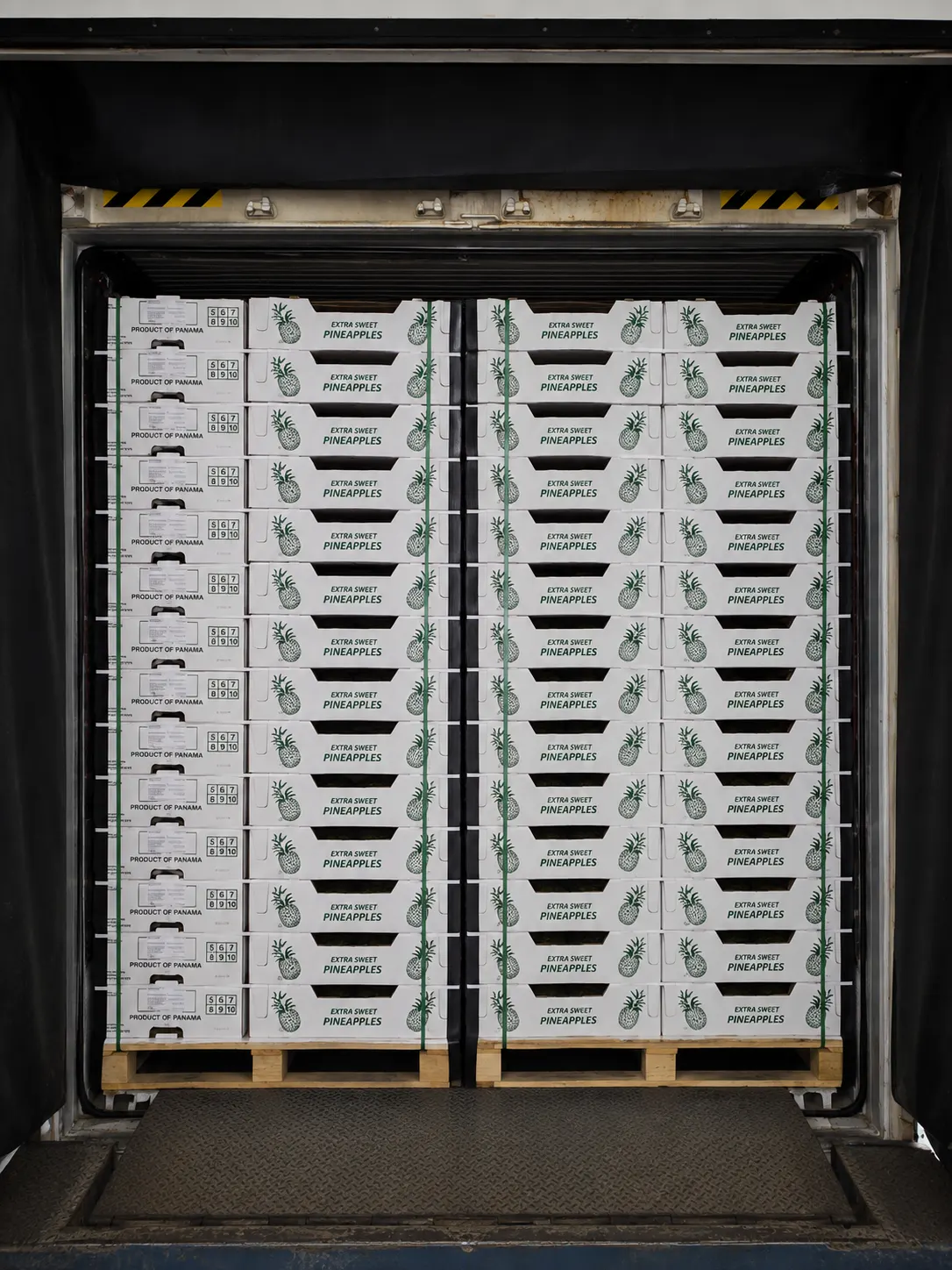
Typical volume: for MD-2 pineapple, ~1,680 cartons of 12 kg (roughly 20,160 kg) per 40' reefer container
Air freight
Use when:
- High value per kilo product (specialty coffee, flowers)
- Commercial urgency (customer needs in 48-72 hours)
- Small volume doesn't justify container
- Highly perishable product (shelf life < 10 days)
Typical volume: 500-5,000 kg per shipment
Common mistakes (and how to avoid them)
1. Not pre-cooling the product
Product comes out of the field at 28-32°C. If you put it directly into an 8°C container, the condenser can't lower the temperature in time and you generate internal condensation.
Solution: Mandatory pre-cooling to target temperature before loading.
2. Overloading the container
More product = more revenue... until the air doesn't circulate and half the container arrives damaged.
Solution: Respect cooling capacity. Better two good containers than one bad one.
3. Incomplete documentation
A poorly filled certificate can block the container at destination for days. The product is lost waiting.
Solution: Triple review before dispatch. Use checklists.
4. No Plan B
The ship is delayed, the port closes, there's a strike. Happens more than you think.
Solution: Always have an alternative: another carrier, alternate port, emergency air option.
How we work at Dulce Tropical
Our proposition is simple: complete execution from origin to destination port.
- We handle harvest and packing at our farms
- We validate documentation before dispatch
- We monitor cold chain in real time
- We align with destination agents for smooth reception
We don't leave to chance what can be controlled.
If you're structuring an export program from Panama — whether pineapple, dragon fruit, coffee or any premium tropical — contact us. We'll help you map the complete chain and execute without surprises.