Quality Standards for Panama Tropical Exports
How to define specs, lot control, and origin quality control for premium tropical export programs from Panama.
Quality Standards for Panama Tropical Exports
In tropical product exports, quality isn't an abstract concept. It's a set of measurable parameters that determine whether your product enters the destination market, whether the buyer pays the agreed price, and whether the commercial relationship continues.
If you're exporting — or buying — tropical products from Panama, this article explains how quality standards work in practice.
Why "quality" doesn't mean the same thing to everyone
When a producer says "my fruit is top grade," what exactly does that mean? Top grade according to whom?
The problem is that without written specifications:
- The producer has one definition
- The exporter has another
- The importer has another
- The supermarket has yet another
Result: Claims, price adjustments, rejected product, broken relationships.
The solution is simple but requires discipline: written specifications and verifiable control.
Components of a quality standard
A complete quality standard for tropical products includes:
1. Physical parameters
| Parameter | What it measures | Why it matters |
|---|---|---|
| Caliber/weight | Fruit size | Presentation, packing, price |
| Color | Maturity state | Shelf life, visual appeal |
| Shape | Symmetry, defects | Retail acceptance |
| Firmness | Texture | Transport resistance |
2. Chemical parameters
| Parameter | What it measures | Why it matters |
|---|---|---|
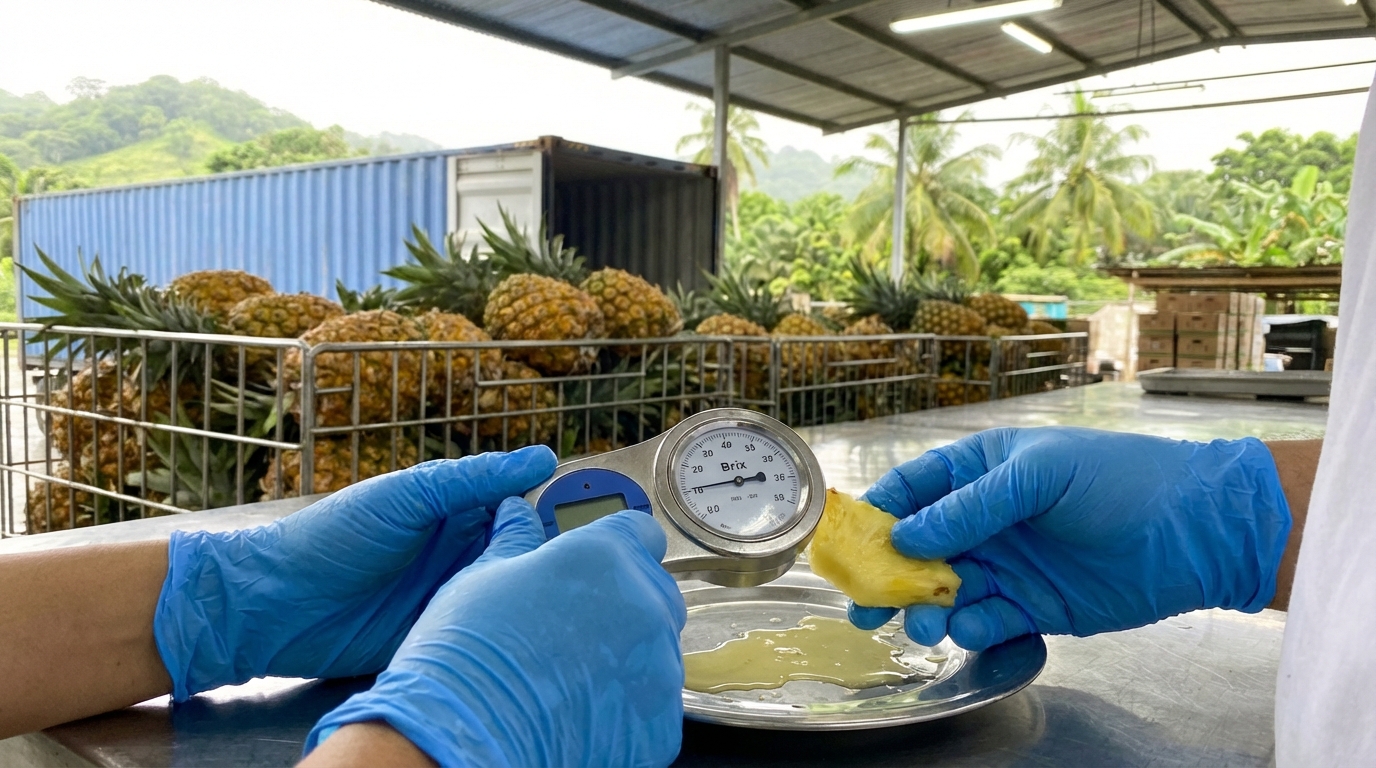
| °Brix | Sugar content | Flavor, maturity |
| Acidity | pH, organic acids | Flavor balance |
| Brix/Acidity ratio | Sweetness/acidity balance | Sensory profile |
3. Phytosanitary parameters
| Parameter | What it measures | Why it matters |
|---|---|---|
| Pest presence | Insects, larvae | Entry requirement |
| Diseases | Fungi, bacteria | Shelf life, safety |
| Chemical residues | Pesticides, fungicides | Regulatory compliance |
4. Defect tolerances
| Defect type | Typical tolerance |
|---|---|
| Major defects | 0-2% |
| Minor defects | 5-10% |
| Cosmetic defects | 10-15% |
| Total cumulative | Variable by market |
Clear definitions: what is "major" vs. "minor" defect
This is one of the areas where most conflicts occur. Without clear definitions, everything is interpretation.
Major defects (cause rejection)
-
Internal damage: Browning, decomposition, fermentation
-
Pest presence: Live larvae, insects
-
Rot: Any visible decomposition area
-
Severe mechanical damage: Deep cuts, extensive bruising
-
Contamination: Foreign substances, abnormal odors
Minor defects (accepted with tolerance)
-
Superficial scarring: Healed marks not affecting flesh
-
Color variation: Uneven tones not indicating problems
-
Light mechanical damage: Small bruises without internal effect
-
Slight deformation: Minor asymmetry not affecting marketability
Cosmetic defects
-
Natural spots: Pigmentation that isn't disease
-
Rub marks: Contact between fruits during transport
-
Washable dust or residue: Cleanable without product damage
Origin control: where quality is won (or lost)
Quality isn't inspected at the end. It's built at every stage:
At the farm
| Control point | What to verify |
|---|---|
| Pre-harvest | Maturity, pest absence, phytosanitary applications |
| Harvest | Cutting technique, handling, time of day |
| Immediate post-harvest | Cleaning, initial selection, sun protection |
| Transport to packhouse | Time, temperature, mechanical protection |
At the packhouse
| Control point | What to verify |
|---|---|
| Reception | Temperature, origin documentation |
| Selection | Caliber, defects, maturity |
| Treatment | Washing, fungicide, HWT if applicable |
| Packing | Presentation, labeling, traceability |
| Pre-cooling | Target temperature reached |
| Palletizing | Correct configuration, identification |
At shipment
| Control point | What to verify |
|---|---|
| Container | Cleanliness, pre-cooling, reefer function |
| Loading | Air distribution, no overloading |
| Documentation | Certificates, B/L, invoice match |
| Sealing | Seal intact, number recorded |
Sampling and verification
You can't inspect 100% of the product. That's why sampling protocols exist:
Standard sampling (based on lot size)
| Lot size | Minimum sample | Acceptance level |
|---|---|---|
| < 500 boxes | 20 fruits | 95% conforming |
| 500-2000 boxes | 50 fruits | 95% conforming |
| > 2000 boxes | 80 fruits | 95% conforming |
What to do with results
- 95%+ conforming: Lot approved
- 90-95% conforming: Conditional lot (requires price adjustment or re-selection)
- < 90% conforming: Lot rejected (doesn't ship or must be repacked)
Quality documentation
Documentation isn't bureaucracy. It's your backup when there's a claim.
Essential documents
-
Lot sheet: Origin, harvest date, variety, treatments
-
Inspection report: Sampling results, measured parameters
-
Temperature record: Cold chain data logger
-
Phytosanitary certificate: Issued by competent authority
-
Photographs: Visual evidence of condition at shipment
Why it matters
When the buyer claims "the fruit arrived damaged," you have two options:
- Pay the claim because you can't prove it left in good condition
- Present documentation proving the problem occurred in transit or at destination
Documentation turns disputes into fact-based conversations.
Relevant certifications
Depending on destination market, certain certifications are requirements or differentiators:
| Certification | What it covers | Markets |
|---|---|---|
| GlobalG.A.P. | Good agricultural practices | Europe, premium retail |
| HACCP | Food safety | All markets |
| FSMA | FDA requirements | United States |
| Organic | Production without synthetic chemicals | Premium, niche |
| Rainforest Alliance | Sustainability | Europe, US |
| Fair Trade | Fair trade practices | Europe, ethical retail |
How we work at Dulce Tropical
Our quality proposition includes:
- Specification alignment: We define written standards before the first shipment
- Origin quality control: Personnel at farm and packhouse during program
- Documented sampling: Reports with photos and data for each lot
- Traceability: Identification from farm to destination
- Claims resolution: Clear process with evidence to determine responsibility
We don't promise "quality." We promise clear specifications, verifiable control, and supporting documentation.
To see how these parameters translate into a working specification, review the Panama MD-2 pineapple export specs. If you want to structure an export program from Panama with professional quality standards, contact us. We'll help you define specifications that work for your market and execute them consistently.