
Pineapple Caliber & Box Count Guide for Importers
MD-2 pineapple calibers 5-10 explained: per-fruit weights, 12 kg carton counts, pallet and 40' reefer loading, and how to specify a caliber mix.
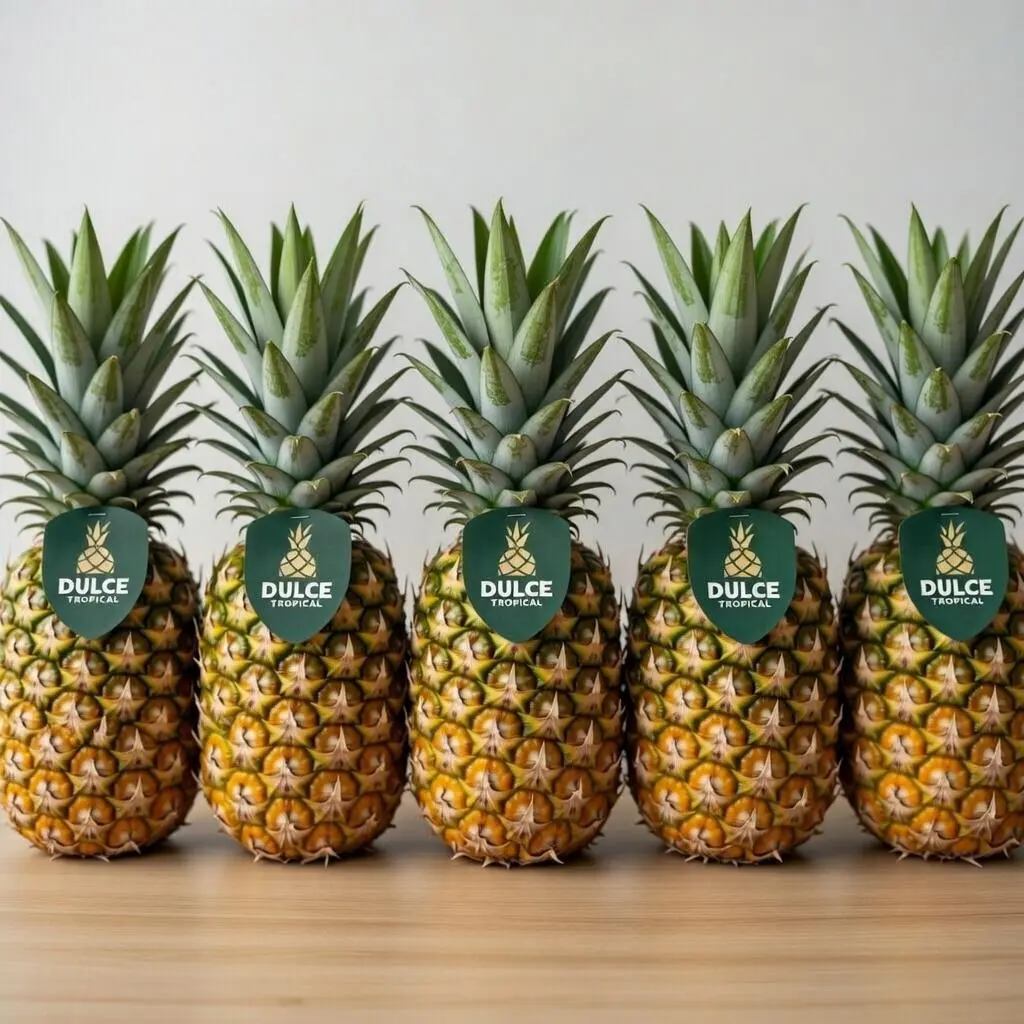
Pineapple Caliber & Box Count Guide for Importers
Every MD-2 pineapple purchase order starts with the same two lines: carton format and caliber mix. Get them right and the fruit arrives matched to your channel. Get them wrong and you unload a container of fruit your customers didn't order.
This guide covers what caliber actually means, the full caliber 5-10 table with per-fruit weights, which counts fit retail, food service, and processing, and the pallet and container math you need to size an order.
What "caliber" means on a pineapple spec
Caliber — also written as "count" or "size" depending on the market — is the number of fruits packed in one export carton. A caliber 6 carton contains 6 pineapples; a caliber 10 carton contains 10.
Because the export carton is a fixed format — 12 kg in our MD-2 program — the count directly defines the weight band of each individual fruit. Fewer fruits per carton means larger fruit; more fruits means smaller fruit. The carton itself stays constant across the whole range, which is what makes caliber such an efficient shorthand: one number tells the packer, the loader, and the receiving inspector exactly what is inside.
Two conventions to keep straight:
- Lower caliber = bigger fruit. Caliber 5 is the largest fruit in the standard export range; caliber 10 is the smallest.
- Caliber is per carton, not per pallet or container. Pallet and container quantities are calculated separately — the math is below.
MD-2 caliber table: the 12 kg export carton
All calibers in our program are packed in the same 12 kg export carton. Available sizes run from caliber 5 to caliber 10:
| Caliber | Fruits per carton | Approx. weight per fruit | Typical channel |
|---|---|---|---|
| 5 | 5 | ~2.3-2.5 kg | Premium retail, showpiece displays |
| 6 | 6 | ~1.9-2.1 kg | Standard retail |
| 7 | 7 | ~1.6-1.8 kg | Retail, food service |
| 8 | 8 | ~1.4-1.6 kg | Food service, processing |
| 9 | 9 | ~1.3-1.4 kg | Food service, processing |
| 10 | 10 | ~1.1-1.3 kg | Processing, fresh-cut |
Calibers 6 and 7 are typically the most requested for standard retail programs.
Whatever the caliber, the fruit itself is specified the same way: minimum 12 °Brix (typical range 13-16), external color stage adjusted per destination market, flesh translucency of 25% or less, and external defects within a 5% surface tolerance.
Which calibers fit which channel
Retail: calibers 5-7
Whole-fruit retail sells by the piece, so shelf presence and uniformity drive the choice. Caliber 6 and 7 fruit fits standard produce displays and household consumption patterns, which is why they anchor most retail programs. Caliber 5 works for premium displays and promotional programs where a large, visually dominant fruit justifies the shelf space.
Food service: calibers 7-9
Hotels, caterers, and juice operations buy by yield per fruit and predictability of prep time. A consistent fruit in a known weight band lets a kitchen standardize trimming and portioning. Calibers 7 and 8 (~1.4-1.8 kg) are the usual working range; caliber 9 (~1.3-1.4 kg) suits operations that portion smaller or juice by the unit.
Processing and fresh-cut: calibers 8-10
Cutting plants and juicers care about usable flesh per carton and machine throughput, not shelf appearance. Smaller, uniform fruit runs efficiently on fresh-cut lines, and minor external cosmetic variation matters less once the fruit is peeled. Calibers 8-10 concentrate this demand, often in crownless presentation (see below).
None of these boundaries are rigid — plenty of retail programs take caliber 8 for smaller-format stores, and some processors prefer larger fruit for specific cuts. The table is the starting point for the conversation, not a rule.
Pallet and container math
Order sizing works backwards from the container:
- Per 40' reefer: approximately 1,680 cartons of 12 kg — roughly 20.2 tonnes of fruit per container.
- Fruit count per container: at ~1,680 cartons, a single-caliber load carries on the order of 8,400 fruits at caliber 5 up to 16,800 at caliber 10; a retail-led mix around calibers 6-7 lands near 10,000-11,800 pieces.
- Per pallet: a common loading plan is about 20 pallets per 40' reefer, which works out to approximately 84 cartons per pallet. The exact configuration depends on pallet standard and stacking pattern, and the final loading plan is confirmed per program before each shipment.
- Carriage conditions: 7-8°C pulp temperature set point at 85-90% relative humidity, for all calibers.
Properly handled MD-2 holds a 21-28 day post-harvest shelf life under those conditions. Your arrival schedule and distribution window need to fit inside it — a spec conversation about calibers should always include one about transit and rotation.
How to specify a caliber mix in a program
Most container programs ship a mix of calibers rather than a single count, stated as a percentage split per container. A typical retail-led order might read:
40% caliber 6 / 40% caliber 7 / 20% caliber 8
Five points to align at program setup:
- Percentage split per caliber, per container — the core line of the spec.
- Adjacent-caliber tolerance. Field size distribution shifts across the year, so fixed splits typically carry an agreed tolerance into the neighboring caliber rather than a hard cutoff.
- Minimum °Brix and color stage — 12° minimum is the export floor; the target stage depends on your market and transit time.
- Crown specification — standard or crownless, and the condition standard (see next section).
- Labeling — per-fruit stickers, PLU codes, or carton-only marking per destination requirements.
Single-caliber containers are possible, but because the field never produces a single size, they typically require longer planning lead time. We confirm the achievable mix against harvest projections before each shipment window.
Crown and crownless notes
The standard export specification calls for a crown of 10-15 cm, green, intact, and undamaged. Crown condition is one of the first things a receiving QC inspector checks, because a dry or broken crown signals rough handling or age.
Crownless — or reduced-crown — presentation is used mainly by processing and fresh-cut buyers: removing the crown puts more usable fruit into the same carton and removes a step from the cutting line. It changes handling at the packhouse, since the cut surface needs protection, so crownless packing is confirmed per program rather than offered as a default.
For retail, the full green crown stays: it is part of the product's shelf identity and a live freshness indicator.
Building your specification
Caliber, carton, mix, crown: four decisions that define most of an MD-2 order before quality parameters even enter the discussion. The full technical specification — Brix, color stages, translucency, cold chain, and logistics — is on our Panama MD-2 pineapple export program page.
If you are sizing a program, contact us with your destination, channel, and preferred caliber mix. Each program is quoted to specification — volume, mix, frequency, and destination port — rather than from a published list.