Route overview
| Parameter | Detail |
|---|---|
| Ocean transit | Typically approximately 5–8 days from Panama to Eastern Canada; confirmed per routing and program |
| Typical entry lanes | Montreal or Halifax by ocean, or US East Coast ports with a refrigerated overland leg to Toronto and Montreal — typical lanes, confirmed per program |
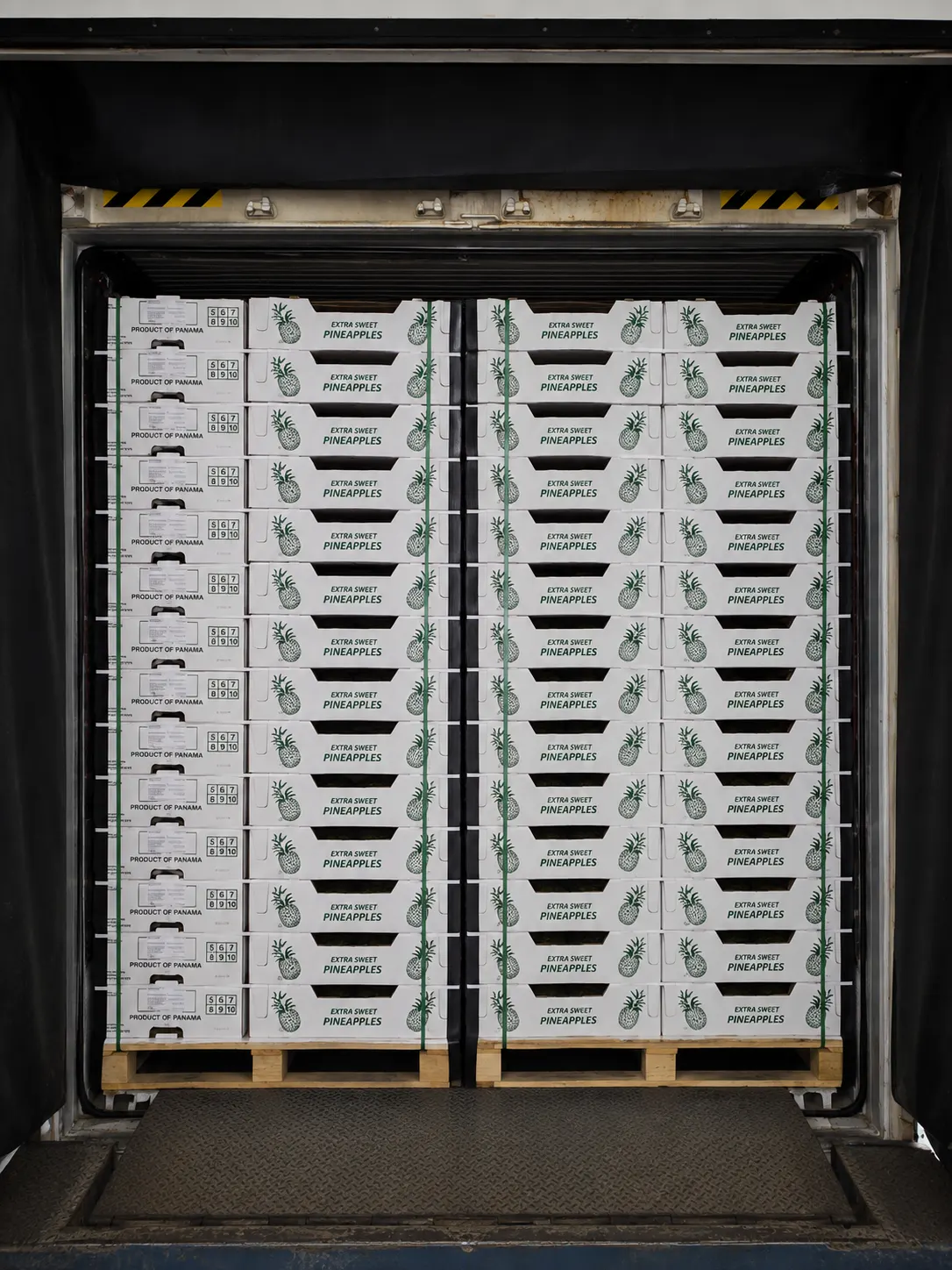
| Mode | 40' reefer container (~1,680 x 12 kg cartons for MD-2 pineapple); air freight for premium or time-sensitive programs |
| Temperature control | 7–8°C pulp and 85–90% RH for MD-2 pineapple; product-specific set points, with winter protection on the inland Canadian leg |
| Shipment frequency | Weekly or bi-weekly container shipments, per each program's demand planning |
| Documentation | Phytosanitary certificate (where required per AIRS), certificate of origin, commercial invoice, packing list, B/L; data for the importer's SFCR licence file and CFIA pre-notification |
Canada is a fully import-reliant tropical fruit market with year-round demand and one of the shortest major northern lanes from Panama: reefer containers typically reach Eastern Canada entry points in approximately 5–8 days. Dulce Tropical grows, packs, and exports MD-2 pineapple and a broad tropical portfolio directly from Panama, with programs structured for Canadian importers, distributors, and retail buyers operating under CFIA and SFCR requirements. Each program is quoted to specification.
Route and logistics execution: Panama to Eastern Canada
Canadian programs typically dispatch from Panama's Atlantic-side terminals at Manzanillo and Colón, at the Caribbean entrance of the Panama Canal. Two lane families serve Eastern Canada: direct or transshipped reefer services into Montreal — the St. Lawrence gateway for Quebec and Ontario distribution — or Halifax, an ice-free deep-water Atlantic port; and discharge at established US East Coast fresh-produce gateways such as Philadelphia, with an in-bond, temperature-controlled overland leg into Toronto or Montreal. These are typical lanes: the port pair, carrier, and schedule are confirmed per program at booking, and ocean transit typically runs approximately 5–8 days.
The lane economics favor shelf life. MD-2 pineapple is pre-cooled within 6 hours of harvest to a 7–8°C pulp set point and consolidated at 85–90% relative humidity in temperature-monitored 40' reefers holding approximately 1,680 fourteen-kilogram export cartons. Against a 21–28 day post-harvest shelf life, a transit of approximately 5–8 days — plus a trucking day or two on overland routings — leaves most of the fruit's commercial life available for Canadian distribution and retail shelf. For short-shelf-life fruit such as papaya, we run air freight options out of Panama with reference transits of 24–48 hours to North America, confirmed per program.
The northern leg adds a cold-weather discipline that tropical lanes elsewhere do not require. MD-2 pineapple is chill-sensitive — extended exposure below its 7–8°C set point risks chilling injury, not just quality loss — and winter ambient temperatures in Ontario and Quebec routinely run far below freezing. Modern reefer units hold set point by heating as well as cooling, so the container itself protects the fruit in transit; the exposure points are unpowered dwell at terminals and the final trucking leg, which in winter is executed on temperature-controlled equipment with minimized dock time. We align arrival scheduling and equipment requirements with the consignee before dispatch, so the last kilometers do not undo a well-run ocean leg.
CFIA, SFCR, and Canadian market access requirements
Canada's food import regime is administered by the Canadian Food Inspection Agency (CFIA) under the Safe Food for Canadians Regulations (SFCR), in force since January 2019. The Canadian importer generally must hold a Safe Food for Canadians import licence, maintain a written preventive control plan (PCP) covering the food it imports, and — for fresh fruits and vegetables — generally must also hold membership in the Fruit and Vegetable Dispute Resolution Corporation (DRC). Our role as the exporter is to make those obligations manageable: we provide per-product technical specifications, lot-level traceability from field to container, and the food-safety documentation defined in each program, so the importer's PCP and supplier-verification records are built on verifiable origin data.
Commodity admissibility is confirmed through CFIA's Automated Import Reference System (AIRS), which returns the current import conditions by HS code, origin, and end use — for fresh pineapple, the reference classification is HS code 0804.30. Import declarations are transmitted ahead of arrival through the CBSA Single Window, carrying the CFIA pre-notification data, and shipments remain subject to inspection at the port of entry. We verify the applicable AIRS conditions for each product in the program before the first shipment and issue the phytosanitary certificate in Panama where the import conditions require one.
Certification pathways — GlobalG.A.P.-type farm assurance, HACCP-based packinghouse controls, and retailer-specific schemes such as programs recognized under CanadaGAP — are defined per program: certification scope is aligned per program and confirmed during quotation. Canadian national retail chains typically apply their own supplier onboarding and audit protocols on top of the SFCR; we align the documentation package, traceability records, and any required scheme evidence with the specific buyer before contracting the program.
Incoterms, documentation, and bilingual labeling
Canadian programs are structured under FOB Panama port (Manzanillo/Colón) or CFR/CIF to a named Canadian port such as Montreal or Halifax, depending on how much of the lane the buyer prefers to control; overland routings via US East Coast ports are structured with the delivery point and responsibility split fixed in the program specification. There is no list pricing in this category — each program is quoted to specification, factoring caliber mix, packaging, freight mode, frequency, and the agreed Incoterm.
The per-shipment document set includes the commercial invoice, packing list, certificate of origin, phytosanitary certificate where the AIRS import conditions require one, and bill of lading, plus the per-shipment data the importer's customs broker needs for the advance declaration. Panama and Canada have had a bilateral free trade agreement in force since 2013, and where preferential tariff treatment applies, the origin documentation is prepared to support it. We validate the complete document set before vessel departure — with fresh fruit, a documentation hold at destination is paid for in shelf life.
For retail-ready and private-label programs, Canadian consumer packaging carries bilingual obligations: mandatory label information — common name, net quantity in metric units, and related declarations — must generally appear in both English and French, with country-of-origin marking per Canadian requirements, and Quebec applies additional French-language rules to product marketing. We execute buyer-approved bilingual artwork on export cartons and consumer units at packing, with label proofs signed off before the first shipment; label formats, PLU coding, and private-label specifications are confirmed per program.
Why Panama origin for Canadian buyers
Canada produces no commercial tropical fruit: demand for pineapple and papaya is met entirely by imports, in every month of the year. That makes supply continuity — not seasonality — the buying criterion, and it is where Panama's profile fits: MD-2 pineapple produced year-round with typical Brix of 13–16° (12° export minimum), structured harvest scheduling to hold volumes consistent, and a lane short enough — typically approximately 5–8 days — that arrival quality is a matter of execution rather than luck.
Winter sharpens the case. From roughly November through April, domestic Canadian fruit production is minimal and import reliance peaks — exactly when Panama's December-to-April dry season opens the export window for watermelon and melons. A Canadian buyer can anchor a year-round pineapple program and layer counter-season watermelon and melon volume on the same origin, the same documentation flow, and the same cold chain, rather than re-qualifying a new supplier for each seasonal gap.
The buyer landscape concentrates where our lane lands: national retail chains run centralized produce procurement from the Toronto and Montreal corridors, and importer-distributors cluster around Toronto's Ontario Food Terminal and Montreal's wholesale market — both within a short trucking radius of the typical entry points. The model behind the lane is direct: Dulce Tropical grows, harvests, packs, and exports from its own operations in Panama — pineapple from the La Chorrera region — with maturity control by index and °Brix and full field-to-container traceability. The same lane can carry our Panama specialty coffee for Canadian roasters, quoted per program.
Products supplied to this market
Frequently asked questions
What is the transit time from Panama to Canada?
Ocean transit from Panama to Eastern Canada typically runs approximately 5–8 days, with Montreal or Halifax as typical entry ports; routings via US East Coast ports add a day or two of trucking to Toronto or Montreal. Final routing and schedule are confirmed per program. For highly perishable fruit such as papaya, air options run with reference transits of 24–48 hours, confirmed at quotation.
What does a Canadian importer need under the SFCR to import fruit from Panama?
The Canadian importer generally needs a Safe Food for Canadians import licence issued by CFIA, a written preventive control plan (PCP) covering the imported food, and — for fresh fruits and vegetables — generally DRC membership as well. Per-commodity import conditions are confirmed through CFIA's AIRS lookup. We support the importer's file with per-product specifications, lot-level traceability, and the food-safety documentation defined in each program.
Do you support bilingual English/French labeling for retail and private-label programs?
Yes. Mandatory label information on Canadian consumer packaging must generally appear in both English and French, and Quebec applies additional French-language requirements. We execute buyer-approved bilingual artwork on export cartons and consumer units at packing, with label proofs signed off before the first shipment; formats, PLU coding, and private-label specifications are confirmed per program.
Can you maintain supply through the Canadian winter?
Yes. Panama's tropical conditions support year-round MD-2 pineapple production under structured harvest scheduling, and papaya offers near-continuous supply; Panama's December-to-April dry season additionally places watermelon and melons exactly in the Canadian winter supply gap. On the logistics side, winter programs run with temperature-controlled equipment on the inland leg and arrival scheduling agreed with the consignee, so fruit is protected from freezing exposure as well as heat. Volumes and windows are confirmed per program.
Is fresh pineapple from Panama admissible into Canada?
Fresh pineapple is generally an admissible commodity into Canada; the current import conditions are confirmed per shipment through CFIA's Automated Import Reference System (AIRS) under HS code 0804.30, and consignments remain subject to inspection at the port of entry. Where the import conditions require a phytosanitary certificate, it is issued in Panama before departure. We verify the applicable AIRS conditions for every product in a program before the first shipment.
Start a supply program
Tell us your destination port, target products, and volumes — we will respond with availability, specifications, and program terms for this market.