Destination market
Tropical Fruit Supplier & Exporter to the GCC (Gulf States) from Panama
Route overview
| Parameter | Detail |
|---|---|
| Ocean transit (typical) | Approximately 20–25 days from Panama to the Middle East, confirmed per program and carrier rotation |
| Regional gateway | Jebel Ali (Dubai) as the typical port of discharge; redistribution to the wider GCC via re-export or direct routings per program |
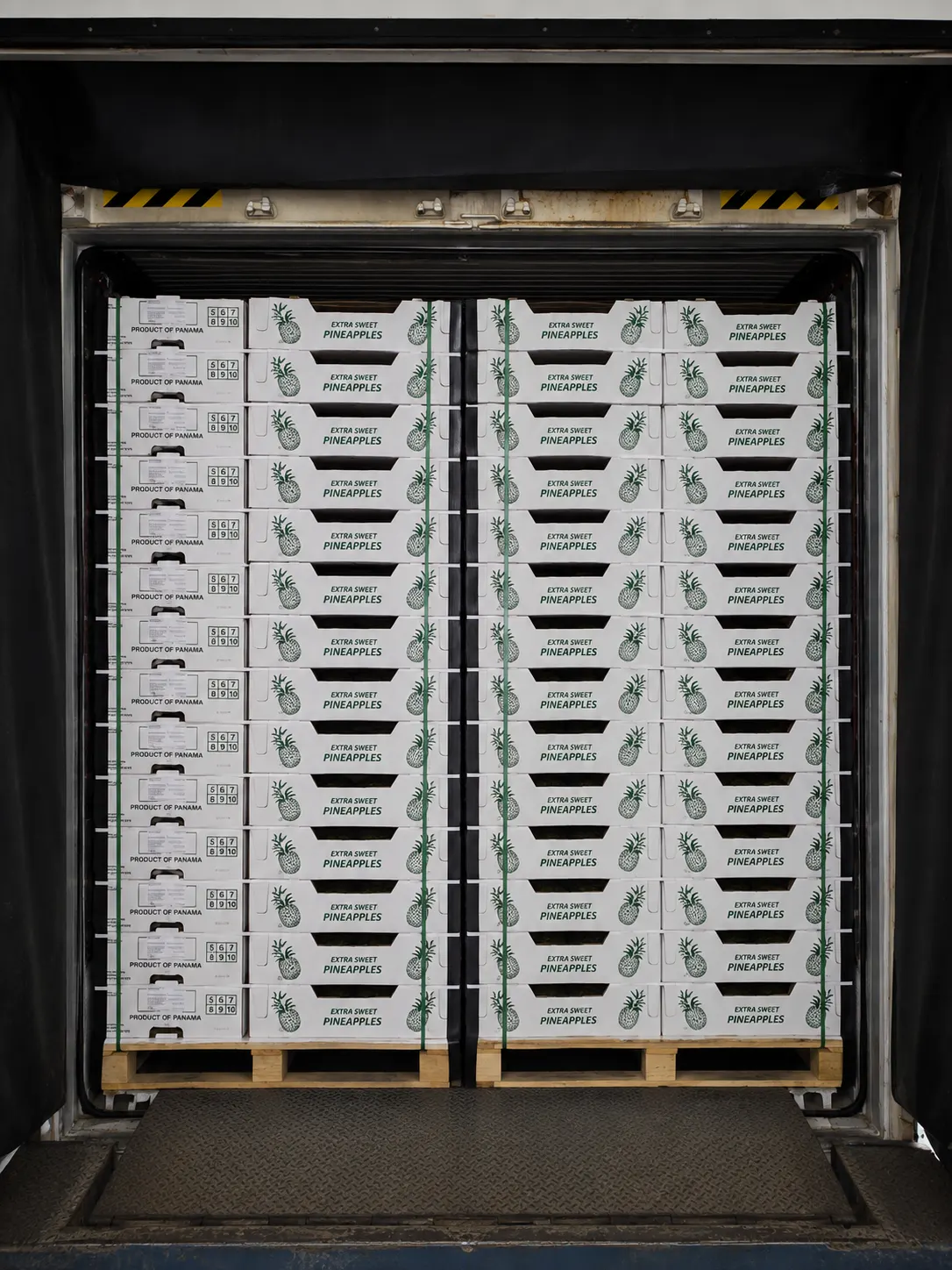
| Freight modes | Refrigerated 40' reefer ocean programs as the base (~1,680 x 12 kg cartons for MD-2 pineapple); air freight to Gulf capitals for premium or time-sensitive lines, per program confirmation |
| Temperature control (MD-2) | 7–8°C pulp set point, 85–90% relative humidity; 21–28 day post-harvest shelf life |
| Frequency | Weekly or bi-weekly container capability subject to demand planning; confirmed per program |
| Regulatory framework | Harmonized Gulf (GSO) food standards applied by each member state: UAE (Dubai Municipality), Saudi Arabia (SFDA), Qatar, Kuwait, Oman, and Bahrain |
First Panamanian entity to establish an active logistics route to the UAE. Dulce Tropical grows, packs, and exports MD-2 pineapple and tropical fruit directly from our Panama operations to the Gulf, with Jebel Ali (Dubai) as the typical entry point and programs structured for direct UAE distribution, re-export to Saudi Arabia, Qatar, Kuwait, Oman, and Bahrain, or direct-air service per program. Each program is quoted to specification for importers, distributors, and retail and food-service buyers across the GCC.
Route and logistics execution: Panama to the Gulf via Jebel Ali
Our Gulf program is built on Panama's two-ocean port infrastructure. Containers are dispatched through the Pacific (Balboa) or the Atlantic (Colón) depending on routing efficiency and carrier rotation, and ocean transit to the Middle East typically runs approximately 20–25 days, with Jebel Ali (Dubai) — the region's largest container port and its established fresh-produce gateway — as the typical port of discharge. Final routing and schedule are confirmed per program. Panama's position on the Canal gives our shipments direct access to eastbound carrier services without inland repositioning, and the same origin infrastructure serves every GCC destination in the program.
A 20–25 day ocean leg leaves no room for cold-chain improvisation. MD-2 pineapple is pre-cooled within 6 hours of harvest to a 7–8°C pulp set point and consolidated at 85–90% relative humidity in temperature-monitored 40' reefers holding approximately 1,680 fourteen-kilogram export cartons per container. Because properly handled MD-2 holds 21–28 days of post-harvest shelf life, the Gulf lane is executed by compressing the harvest-to-load window and staging color and maturity for the destination — and when fruit will continue on a redistribution leg beyond the UAE, the arrival specification is tightened further so it reaches shelves in Riyadh, Doha, or Kuwait City with usable commercial life.
Beyond the UAE, GCC destinations are served through two models. The first is re-export: importers operating out of Jebel Ali redistribute fresh produce by land and feeder services across Saudi Arabia, Qatar, Kuwait, Oman, and Bahrain, and we adjust the program specification to that additional leg. The second is direct service per program: air freight from Panama to Gulf capitals for premium retail, hospitality, and short-shelf-life lines such as papaya, and — where volumes and carrier rotations justify it — direct ocean routings to other Gulf ports evaluated at quotation. Which model fits depends on the buyer's network; both are quoted to specification.
Certifications and GCC market access requirements
Food standards across the Gulf are coordinated through the GCC Standardization Organization (GSO), which issues harmonized technical regulations covering food labeling, additives, hygiene, and halal requirements that member states adopt into their national regimes. For fresh fruit, the practical baseline is consistent across the region: GCC markets require a phytosanitary certificate issued at origin — in Panama's case by the national plant-health authority — alongside the certificate of origin and standard commercial documents. Fresh whole fruit contains no animal-derived inputs and is broadly treated as halal by nature; formal halal certification requirements concentrate on processed foods and products with animal-derived ingredients.
Each member state applies the GSO framework through its own authority, and the entry procedure follows the destination. In the UAE, consignments are declared through Dubai Municipality's electronic food import controls, matched to a registered local importer, and inspected at the port of entry. In Saudi Arabia — the GCC's largest consumer market — food imports are regulated by the Saudi Food and Drug Authority (SFDA), with importer registration, electronic declaration, and inspection at the port of entry; where a program is destined for Saudi Arabia, whether through Jebel Ali re-export or direct routing, the SFDA-facing responsibilities sit with the registered importer and are mapped with the consignee before contracting. Qatar, Kuwait, Oman, and Bahrain operate equivalent municipal and ministry-level food-control regimes, and the documentation package is aligned to the specific state of clearance per program.
Certification pathways — GlobalG.A.P.-type farm assurance, HACCP-based packinghouse controls, and related food-safety schemes — are defined per program depending on the destination state and the buyer's own protocol; certification scope is aligned per program and confirmed during quotation. Where a program extends into value-added formats — juices, concentrates, or ingredient lines, executed under our quality program with qualified processing partners in Panama and confirmed per program — halal documentation, additives, and Arabic-language labeling for prepackaged product are mapped against the applicable GSO standards before the first shipment. For fresh fruit destined for GCC retail, carton markings and consumer-facing label data can be prepared to the consignee's Arabic-labeling requirements per program.
Incoterms, documentation, and program structure
GCC programs are typically structured under FOB Panama (Balboa or Colón) or CFR/CIF Jebel Ali as the base; for direct routings to other Gulf ports, CFR/CIF to the named port is evaluated per program, and air programs are typically structured FCA Panama airport. There is no list pricing in this category — each program is quoted to specification, factoring caliber mix, packaging, freight mode, frequency, destination state, and the agreed Incoterm.
The standard document set per container: phytosanitary certificate, certificate of origin, commercial invoice, packing list, and bill of lading, with lot-level traceability from field to container. Documents are transmitted to the consignee ahead of vessel arrival so import clearance can be processed without dwell time — on a 20–25 day lane, every day lost at destination comes directly out of shelf life. For re-export programs, the onward customs and conformity steps into Saudi Arabia, Qatar, Kuwait, Oman, or Bahrain are handled by the consignee's network; we supply the origin documentation and lot data those onward clearances draw on.
The typical minimum shipment for MD-2 pineapple is one 40' reefer holding approximately 1,680 fourteen-kilogram export cartons, with calibers 5–10 available and the caliber mix set to the buyer's channel — retail programs typically concentrate on calibers 6 and 7. Continuous GCC programs run on weekly or bi-weekly planning, with volumes scheduled against the buyer's demand calendar; Ramadan and peak-season windows should be booked in advance and are confirmed per program.
Why Panama origin for Gulf buyers
Fresh-pineapple supply into the Gulf comes predominantly from Asian origins. Panama offers GCC buyers a Western-hemisphere counterweight: year-round MD-2 production with typical Brix of 13–16° (minimum 12° for export), direct grower-exporter execution from our own operations, and dispatch flexibility through either Pacific or Atlantic ports. For an import desk managing origin risk across six national markets, a second hemisphere with independent weather, harvest, and shipping variables is a structural hedge, not just an alternative quote.
The lane is anchored where the region's produce trade is anchored. As the first Panamanian entity to establish an active logistics route to the UAE, we treat Dubai as the lane's entry point: importers operating out of Jebel Ali redistribute across the wider GCC, and bilateral momentum supports the lane — non-oil trade between the UAE and Panama was reported at approximately $186 million in 2025, up nearly 50% year on year. From that gateway, Saudi Arabia represents the GCC's largest population and food-import base, while Qatar, Kuwait, Oman, and Bahrain add distinct retail and hospitality channels — each reached by re-export or direct service, confirmed per program.
Demand across the GCC is seasonal in a way that rewards planning: Ramadan lifts consumption of fresh fruit and juices for iftar across all six markets, and the October–April tourism and hospitality season sustains premium food-service volume, particularly in the UAE and Qatar. Because Panama's tropical conditions allow structured year-round harvest scheduling, Ramadan and peak-season volumes can be booked in advance rather than sourced spot. The same lane carries our Panama specialty coffee — a category in which Gulf roasters, notably in the UAE and Saudi Arabia, have become prominent buyers of Panamanian lots. Volume windows for each demand peak are confirmed per program.
Products supplied to this market
Frequently asked questions
How long does shipping take from Panama to GCC markets?
Ocean transit from Panama to the Middle East typically runs approximately 20–25 days, with Jebel Ali (Dubai) as the typical discharge port; onward redistribution to Saudi Arabia, Qatar, Kuwait, Oman, or Bahrain adds time that depends on the consignee's network and is planned into the arrival specification. Air freight options to Gulf gateways are available for premium or time-sensitive shipments, with schedules confirmed at quotation.
Can you supply Saudi Arabia?
Saudi programs are structured either through re-export partners operating out of Jebel Ali or through direct routings evaluated per program, depending on the buyer's network and volumes. Food imports into Saudi Arabia are regulated by the SFDA, with the registered importer carrying the declaration and clearance responsibilities; we map the documentation package and arrival specification with the consignee before contracting, and each program is quoted to specification.
Is halal certification required for fresh fruit in GCC markets?
Fresh whole fruit contains no animal-derived inputs and is broadly treated as halal by nature; formal halal certification requirements under the Gulf (GSO) framework concentrate on processed foods and products with animal-derived ingredients. Where a program extends into juices, concentrates, or ingredient lines, halal documentation, additive rules, and Arabic-language labeling are mapped per product against the applicable GSO standards before the first shipment.
Can you scale volumes for Ramadan demand across the region?
Yes. Panama's growing conditions allow year-round MD-2 production under structured harvest scheduling, so Ramadan volumes for UAE distribution and GCC re-export can be planned and booked in advance rather than sourced spot. We recommend confirming Ramadan programs several weeks ahead of the demand window; specific volumes, calibers, and destinations are confirmed per program.
What documents are required to import Panamanian fruit into GCC markets?
The standard set is a phytosanitary certificate issued in Panama, certificate of origin, commercial invoice, packing list, and bill of lading, with lot-level traceability. Clearance then follows the destination state: in the UAE, the registered importer declares through Dubai Municipality's food import controls; in Saudi Arabia, through the SFDA regime; Qatar, Kuwait, Oman, and Bahrain operate equivalent national controls. We transmit documents ahead of arrival and align the package to the specific state of clearance per program.
Start a supply program
Tell us your destination port, target products, and volumes — we will respond with availability, specifications, and program terms for this market.