Destination market
Tropical Fruit Supplier & Exporter to the United States from Panama
Route overview
| Parameter | Detail |
|---|---|
| Ocean transit | Typically 3–6 days to US East Coast and Gulf ports; confirmed per routing and program |
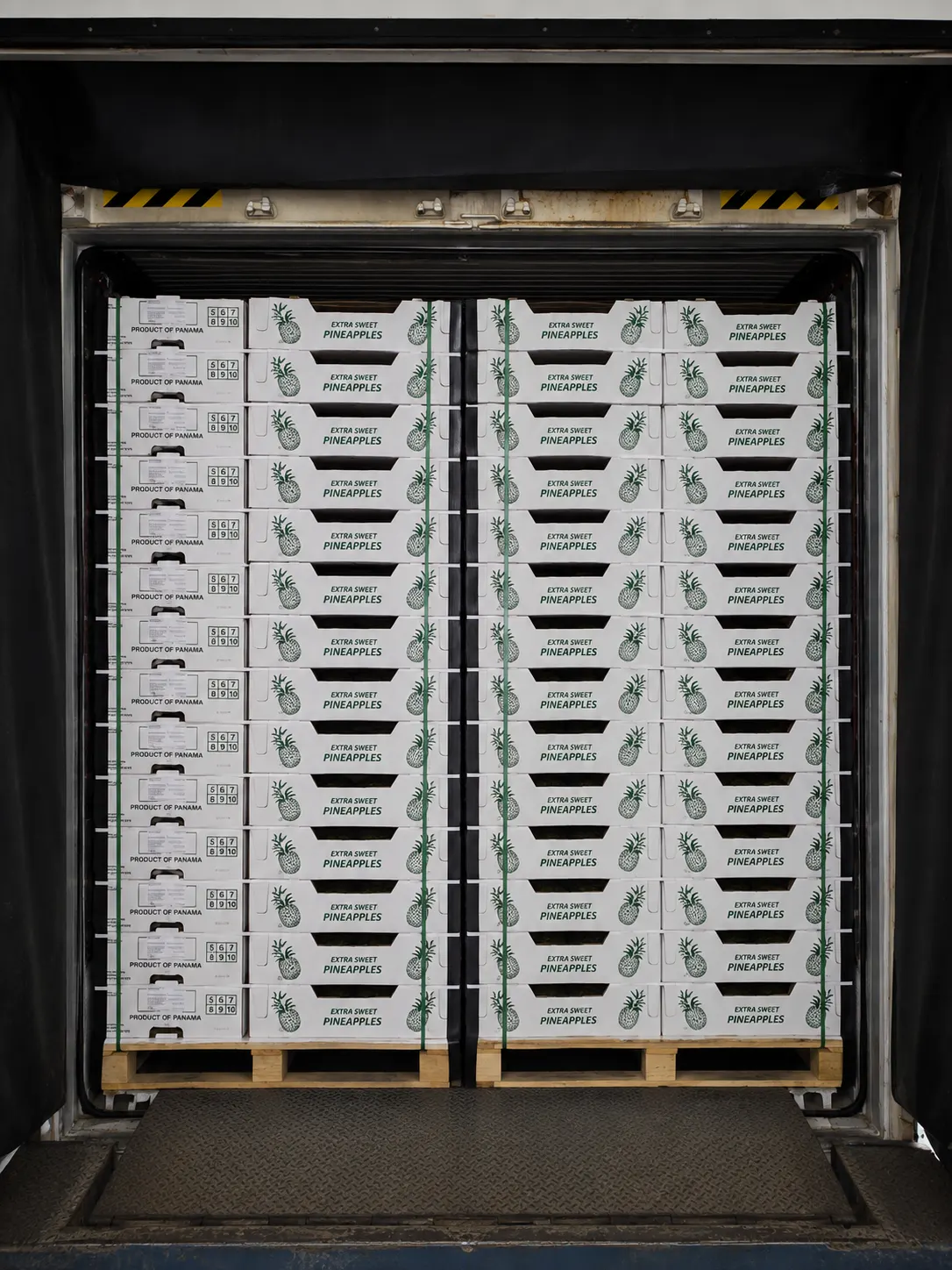
| Mode | 40' reefer container (~1,680 x 12 kg cartons for MD-2 pineapple); air freight for premium or time-sensitive programs |
| Typical destination ports | Manzanillo/Colón (Atlantic) to Port Everglades, Philadelphia, or Houston as typical lanes, confirmed per program |
| Temperature control | 7–8°C pulp and 85–90% RH for MD-2 pineapple; product-specific set points for dragon fruit, papaya, and melons |
| Shipment frequency | Weekly or bi-weekly container shipments, per each program's demand planning |
| Documentation | Commercial invoice, packing list, phytosanitary certificate, certificate of origin, B/L, and FDA Prior Notice data |
The United States is the closest major import market to Panama: reefer containers loaded at Panama's Atlantic terminals typically reach US East Coast and Gulf ports in a matter of days, not weeks. Dulce Tropical grows, packs, and exports MD-2 pineapple and a broad tropical portfolio directly from Panama, with programs structured for importers, distributors, and food-service buyers operating under FDA and USDA requirements. Each program is quoted to specification.
Route and logistics execution: Panama to US ports
Panama operates with access to two oceans. For US programs, refrigerated cargo is typically consolidated at the Atlantic terminals of Manzanillo and Colón, at the Caribbean entrance of the Panama Canal, with usual discharge at Port Everglades (South Florida), Philadelphia (an established East Coast fresh-produce gateway), or Houston (Gulf distribution). These are typical lanes: the port pair, carrier, and schedule are confirmed per program at booking. For West Coast programs, a Pacific option via Balboa is available, with longer transits — approximately 8–10 days — subject to program confirmation.
The cold chain defines the commercial outcome. For MD-2 pineapple, fruit is pre-cooled within 6 hours of harvest and travels at a 7–8°C pulp set point with 85–90% relative humidity in temperature-monitored containers. With a 21–28 day post-harvest shelf life under those conditions, an ocean transit of just a few days to the East Coast or Gulf leaves most of the shelf life available for US distribution and retail. A 40' reefer container holds approximately 1,680 x 12 kg export cartons.
For continuous supply programs we execute weekly or bi-weekly shipments based on the buyer's demand planning. Highly perishable products such as papaya can move by air freight, with reference transits of 24–48 hours to North America subject to program confirmation; air freight is also available as an option for premium or time-sensitive shipments of other portfolio products.
Certifications and US market access requirements
The US food import regime is built around the FDA and the Food Safety Modernization Act (FSMA). Foreign facilities that manufacture, process, pack, or hold food for US consumption must generally be registered with the FDA (farms as such are largely exempt from registration), and every shipment requires a Prior Notice filed before arrival — for ocean freight, no less than eight hours in advance. Fresh fruit is additionally subject to FSMA's Produce Safety Rule, which sets production standards for farms supplying the US market.
Under FSMA, the Foreign Supplier Verification Program (FSVP) places direct obligations on the US importer: it must be a US-based entity, conduct the hazard analysis, verify its foreign supplier, and keep auditable records. Our role as the exporter is to make that verification straightforward: we provide per-product technical specifications, lot-level traceability from field to container, and the food-safety documentation defined in each program, so the importer's FSVP file is built on verifiable origin data.
On the phytosanitary front, admissibility is defined by USDA-APHIS commodity by commodity, with CBP agricultural inspection at the port of entry. Fresh pineapple is generally an admissible commodity into the United States subject to inspection on arrival; other products carry commodity-specific conditions, which are confirmed when each program is structured. Every shipment travels with its phytosanitary certificate issued in Panama. Certification pathways — such as GlobalG.A.P.-aligned production protocols and HACCP-based food-safety programs — are defined per program, depending on buyer and destination-market requirements.
Incoterms and documentation
Commercial terms are defined per program, and each program is quoted to specification. The usual structure for the United States is FOB Panama port, with CFR or CIF options to a named US port when the buyer prefers freight execution on our side. Incoterm, caliber, packaging, frequency, and supply window are fixed in the program specification before the first shipment.
The per-shipment documentation package includes the commercial invoice, packing list, certificate of origin, phytosanitary certificate issued in Panama, bill of lading, and the data needed for the FDA Prior Notice to be filed on time. For fresh pineapple, the reference tariff classification is HS code 0804.30. We validate the full document set before vessel departure: a badly issued certificate can hold a container at destination for days, and with fresh fruit that cost is never recovered.
On the US side, the importer's customs broker files the entry with CBP, CBP agriculture specialists perform the inspection at the port of entry, and the FSVP importer is identified at entry. Before vessel departure we align our document set with the buyer's broker requirements, so that reception at Port Everglades, Philadelphia, or Houston flows without avoidable holds.
Why Panama origin for US buyers
Proximity is shelf-life economics. A typical 3–6 day ocean transit to the East Coast or Gulf — versus weeks from Asian origins or longer South American routings — means an MD-2 pineapple with a 21–28 day post-harvest shelf life arrives with most of its selling days intact. For papaya and dry-season fruit, that transit-day difference versus more distant origins translates directly into freshness on the US shelf.
Panama's calendar combines continuity and counter-season supply. MD-2 pineapple is produced year-round, with structured harvest scheduling to sustain consistent volumes; papaya offers near-continuous supply. In parallel, the December-to-April dry season places watermelon and melons exactly in the Northern Hemisphere winter gap, and dragon fruit adds seasonal windows confirmed per program. One origin can cover year-round pineapple programs and complementary seasonal windows through a single logistics chain.
And the model is direct: Dulce Tropical grows, harvests, packs, and exports from its own operations in Panama — pineapple from the La Chorrera region — with maturity control by index and °Brix, and full field-to-container traceability. We supply importers and distributors in North America with the connectivity of the Panama Canal logistics hub: sailing frequency, two-ocean routing options, and an execution chain that stays under one accountable party from farm to destination port.
Products supplied to this market
Frequently asked questions
Can you supply MD-2 pineapple to US importers year-round?
Yes. Panama's tropical growing conditions support year-round MD-2 pineapple production with structured harvest scheduling. The typical minimum shipment is one 40' reefer container (~1,680 x 12 kg cartons), with weekly or bi-weekly cadence for continuous supply programs based on demand planning.
What is the ocean transit time from Panama to the United States?
Reference transits are 3–5 days to the US East Coast and typically up to 6 days to Gulf ports, depending on routing. West Coast programs via Balboa run longer, at approximately 8–10 days. Final transit is confirmed per program at the time of vessel booking.
Who is responsible for FDA Prior Notice and FSVP?
Prior Notice is filed with the FDA before the shipment arrives — for ocean cargo, no less than eight hours in advance — and is normally handled by the customs broker or importer using the per-shipment data we provide. FSVP obligations rest by law with the US importer; we support your FSVP file with technical specifications, lot-level traceability, and the food-safety documentation defined in each program.
What documentation accompanies each shipment to the United States?
Each shipment travels with a commercial invoice, packing list, certificate of origin, phytosanitary certificate issued in Panama, and bill of lading, plus the data for the FDA Prior Notice. We validate the complete document set before vessel departure and align it with your company's customs broker requirements to avoid holds at the port of entry.
Start a supply program
Tell us your destination port, target products, and volumes — we will respond with availability, specifications, and program terms for this market.