Destination market
Tropical Fruit Supplier & Exporter to Europe (EU & UK) from Panama
Route overview
| Parameter | Detail |
|---|---|
| Ocean transit | Typically 12-16 days port to port, Panama to North Europe (per program confirmation) |
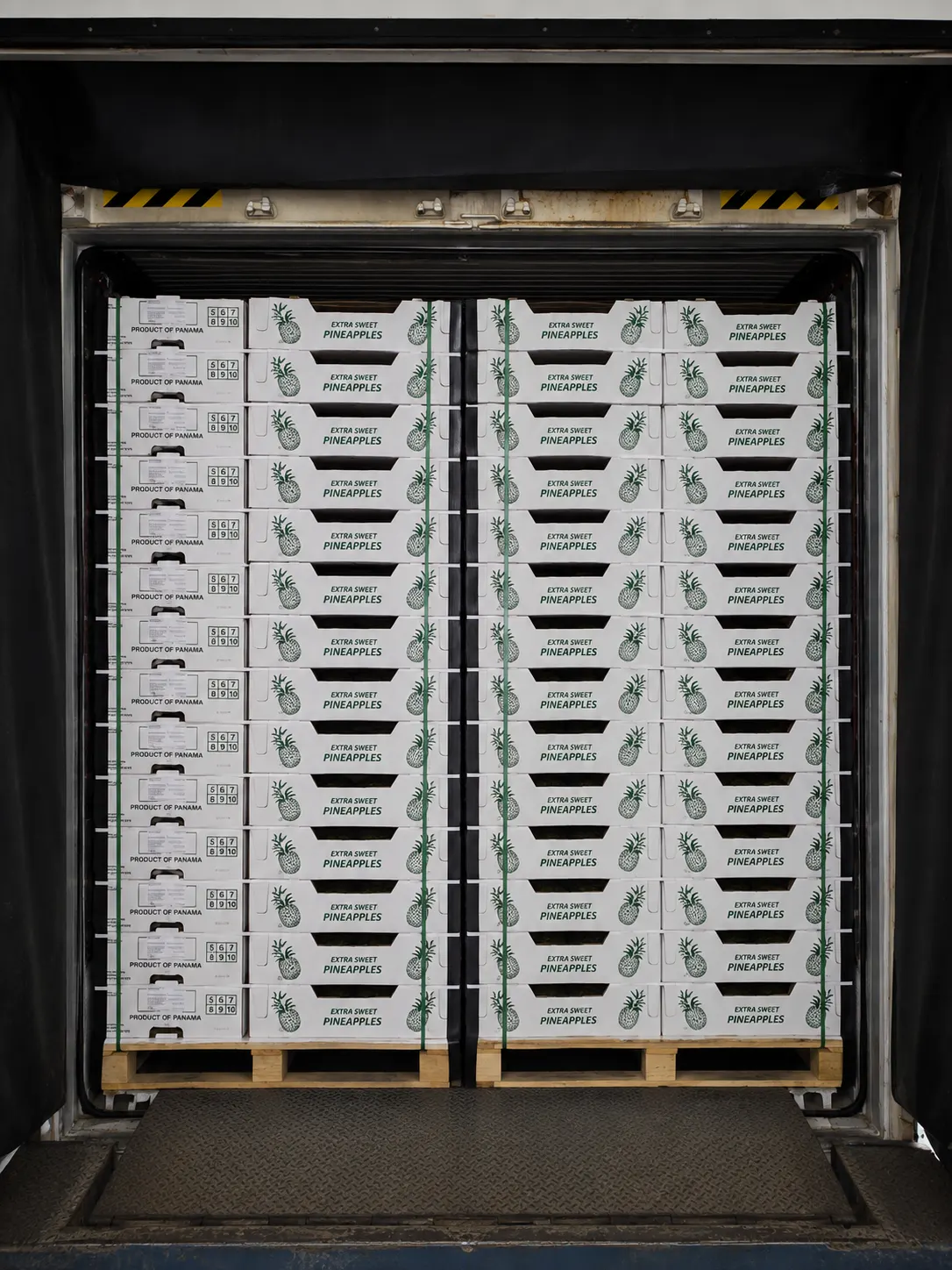
| Mode | 40' reefer container (~1,680 x 12 kg MD-2 cartons); air freight option per program |
| Typical entry ports | Rotterdam, Antwerp, or Algeciras — typical lanes, confirmed per program |
| Temperature control | 7-8°C pulp and 85-90% relative humidity for MD-2 pineapple; product-specific set points |
| Frequency | Typically weekly or bi-weekly shipments per program planning |
| Documentation | Phytosanitary certificate (where required), certificate of origin, TRACES NT pre-notification (where required), commercial invoice, packing list, B/L |
Europe takes the largest share of Panama's pineapple exports and anchors its tropical fruit trade — and it is the market with the most demanding regulatory and retail requirements. Dulce Tropical structures European programs directly from origin: MD-2 pineapple year-round, counter-season watermelon and melon from December to April, and specialty coffee, shipped on typical lanes into Rotterdam, Antwerp, or Algeciras under full cold-chain control. Each program is quoted to specification for EU and UK entry.
Route & logistics execution to Europe
European programs typically dispatch from Panama's Atlantic-side container terminals in Colón, which run direct reefer services to North Europe and the Western Mediterranean. Typical entry ports are Rotterdam and Antwerp for Northwest European distribution, with Algeciras as the southern gateway for Iberia and onward transshipment; the final port pair is confirmed per program against the buyer's inland logistics. Ocean transit to North Europe typically runs 12-16 days port to port.
The Atlantic crossing is longer than the North American lanes, which makes cold-chain discipline the deciding factor. MD-2 pineapple holds 21-28 days of post-harvest shelf life at 7-8°C and 85-90% relative humidity, so a 12-16 day transit consumes roughly half of that window. That is why pre-cooling within 6 hours of harvest is critical, pulp temperature is verified at loading, and consolidation happens in temperature-monitored 40' reefer containers. Every day saved between field and vessel is a day of commercial shelf life delivered to your distribution center.
A standard European shipment is one 40' reefer container holding approximately 1,680 x 12 kg MD-2 export cartons; continuous programs typically run weekly or bi-weekly per demand planning. For program launches, samples, or premium retail windows, air freight options are available per program. Counter-season watermelon and melon move on the same Atlantic lanes during the December-April dry-season window.
Certifications & market access requirements (EU & UK)
The European Union operates a harmonized regulatory regime for imported fruit: maximum residue limits (MRLs) under Regulation (EC) 396/2005, plant-health rules under Regulation (EU) 2016/2031, and consignment pre-notification through TRACES NT. Fresh pineapple carries an unusual advantage — it is one of the few fruits exempt from the EU phytosanitary certificate requirement — while our other lines, such as watermelon, melon, and passion fruit, travel with a phytosanitary certificate issued in Panama. Field programs are planned against EU MRLs, with residue analysis available per program requirement.
For EU retail, GlobalG.A.P. is the de facto market requirement: most Northern European retail chains will not list fresh produce without a valid GGN number, and many add the GRASP social-practice assessment on top. We treat GlobalG.A.P. as the certification pathway for European retail programs — scope and audit status are aligned to each program and destination market and confirmed during quotation, so your category manager knows exactly what documentation backs the listing before the first container sails.
Certification expectations differ by buyer channel. Retail programs (Netherlands, Germany, UK, France) are spec-locked: fixed calibers — 6 and 7 are typically the most requested for standard pineapple retail programs — defined color stages, and certified supply. Wholesale and food-service importers around the Rotterdam hub and Spain's wholesale markets accept broader caliber mixes and shorter commitments, which makes them the practical entry channel for a new origin relationship. The UK now runs its own MRL list and border-control regime post-Brexit, so GB-bound programs are documented separately from EU entries.
Incoterms & documentation
European programs are commonly quoted FOB Panama, with CFR or CIF to Rotterdam, Antwerp, or Algeciras arranged where the buyer prefers a delivered-port structure. There is no price list: each program is quoted to specification — product, caliber mix, certification scope, frequency, and incoterm — so the quotation reflects the actual structure of your lane and volume.
The EU document set travels with every container: commercial invoice, packing list, bill of lading (B/L), certificate of origin, phytosanitary certificate where the product requires one, and TRACES NT pre-notification ahead of arrival where required. Under the EU-Central America Association Agreement, qualifying Panamanian fresh fruit enters the EU with preferential tariff treatment against proof of origin; for the United Kingdom, the Central America-UK continuity agreement carries equivalent preferences, documented as a separate GB customs entry.
Documentation is validated before dispatch, not after: every certificate is cross-checked against the vessel booking, and each lot is traceable from field to container number. A document error discovered at a European border control post can hold a reefer for days — with a 12-16 day crossing already behind it, that is shelf life no program can afford, so we treat pre-shipment document review as a hard release gate.
Why Panama origin for the European market
Europe is the principal destination for Panamanian pineapple — industry estimates place around 70% of Panama's pineapple exports in European markets — and the fruit arrives with the numbers European buyers specify: typical Brix of 13-16 (minimum 12), calibers 5-10 packed in the 12 kg export carton, and 21-28 days of shelf life at 7-8°C. Panama's Atlantic terminals connect to direct North Europe reefer services, keeping the crossing within the fruit's shelf-life budget.
Panama's December-April dry season is the mirror image of Europe's winter supply gap. Watermelon and melon from the dry belt of the central provinces ship toward the United Kingdom and the Netherlands exactly when Northern Hemisphere production is out of season — trade data (CBI) has put Panama at roughly 6-7% of UK and Dutch watermelon imports — and the February-April peak aligns with the strongest European demand window. For European category planners, that makes Panama a structural counter-season origin, not an opportunistic one.
You deal with the grower, not a chain of intermediaries: we grow, pack, and export directly from our Panama operations, with lot-by-lot quality control and one accountable counterpart from field to port of discharge. The same origin relationship extends to Panama specialty coffee — traceable estate lots from Boquete, Volcán, and Renacimiento scoring 84-90+ SCA for European roasters — and to passion fruit and juice and concentrate formats for processing buyers. One origin, one counterpart, multiple European categories.
Products supplied to this market
Frequently asked questions
How long does sea freight take from Panama to Rotterdam?
Ocean transit typically runs 12-16 days port to port from Panama's Atlantic terminals to North European ports such as Rotterdam or Antwerp. For planning, allow approximately 18-24 days from harvest to delivery at your facility, subject to program confirmation. MD-2 pineapple's 21-28 day shelf life at 7-8°C keeps a meaningful commercial window open after arrival.
Do you have GlobalG.A.P. certification for EU retail programs?
GlobalG.A.P. is the de facto requirement for EU retail listings, and it is the certification pathway we align for European retail programs. Scope and audit status depend on the specific program and destination market, and are confirmed in writing during quotation. Wholesale and food-service programs can often start on the standard export documentation set while retail certification scope is aligned.
Which European ports do you ship to?
Typical lanes run to Rotterdam and Antwerp for Northwest Europe, and to Algeciras for Iberia and Mediterranean transshipment; other ports are quoted per program. The final port pair is confirmed against your inland distribution during program setup.
What is the minimum volume for a European program?
The typical minimum is one 40' reefer container — approximately 1,680 x 12 kg cartons in the case of MD-2 pineapple. Continuous programs typically run weekly or bi-weekly shipments based on demand planning; counter-season watermelon and melon programs are structured per container across the December-April window.
Can you supply the UK after Brexit?
Yes. UK-bound programs are documented as separate GB customs entries, taking into account the UK's own MRL framework and border-control regime, with preferential tariff treatment available under the Central America-UK continuity agreement against proof of origin. Route and entry port are confirmed per program.
Start a supply program
Tell us your destination port, target products, and volumes — we will respond with availability, specifications, and program terms for this market.